Office Crashout - 1st Place Winner in the 2025 Viverse Hackathon
Created at the Academy of Art University by Michael Broderick and Adri Denman.
Office Crashout simulates working in an office environment, requiring you to complete multiple tasks within a short period of time. Your coworkers have left on a paid vacation with your boss, and you are left to run the office alone. Prolong your Rage and complete as many tasks as possible before the inevitable "Crashout!" Then destroy anything and everything with weapons and other office supplies for the high score!
Our game won first place in the Games category at the inaugural Viverse Hackathon in late 2025. We developed the game in just over two weeks.

Office Crashout
I took the role of a lead designer on this project; my duties included:
-
Coming up with the idea
-
Writing a game design document to support development
-
Delegated tasks between my partner and me
-
Level design
-
Destruction systems
-
Audio system and integration
-
Player movement and interaction
-
Player art and animation
-
Weapon systems and design
-
Leaderboard system
-
UX/UI design for menus
As the lead designer, I took on most of the work for this project, dedicating over 30 hours a week. I scripted all aspects of player interaction, movement, and necessary systems, such as the item destruction system, using C#.
The Idea:
I came up with the idea with help from a friend who was feeling frustrated with his job. He likes to play video games in his spare time and wanted a place where he could just destroy an office in a fun, expressive way. This led me to the idea of an arcade-like play style with a leaderboard where friends can compete against each other.
Game Design Documentation:
I wrote a thorough game design document listing all possible ideas and the systems needed. It worked as a cornerstone for my partner and me to reference whenever we felt stuck. I wrote it in a way where we could change it on the fly due to time constraints. The document explained the full story, player interaction, player movement, combat, item system design, item lists, and much more.
Additionally, mood boards and brainstorming activities took place between my partner and I.
Delegated Tasks:
As the lead designer, it was important that I stayed on task and had proper version control to share with my partner. I set up the version control using Unity's built in Dev-ops system and showed my partner how to properly use it to avoid file corruption and rollbacks. With the help of the game design document, I was able to keep my partner on task, working on the task systems and mini-games. I offered critique and formatting support to integrate it smoothly.
Level Design:
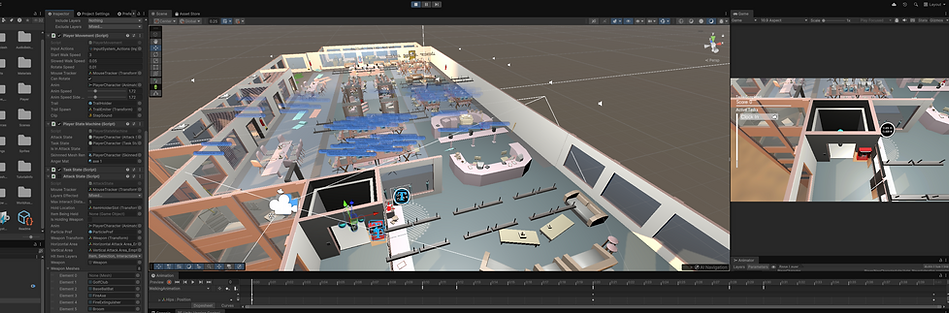
I built the level to look similar to modern-day offices with a reception, work area, break rooms, team lead offices, and the main boss's office. I had the player start at the bottom of the level so that they could get a good visual of the level layout as they began playing. I wanted the player to feel like they could get to tasks efficiently and without getting lost, so I integrated a compass system on the active task list. This helps the players navigate to the tasks that are almost out of time and to keep track of how many tasks are active. I referenced a multitude of real office layouts and considered how the space would be "lived in".
Destruction Systems:
I designed the destruction system to allow any object to become destructible by just adding a couple of scripts. The item logic allows the player to pick up, throw, deal damage, and break items. I also added a point system to keep track and come up with the final score based off how many points they acquired multiplied by how many tasks they completed prior to the destruction phase.